

7 Reasons For A Small Business Website Redesign

Even the most aesthetically pleasing and user-friendly small business websites eventually need a facelift. At hypersite, we recommend a small business website redesign every 30 months max (approximately 2.5 years). At face value, this may seem quick. But unlike certain industries that seem to never change, or change very little through the years (think plumbing, aviation, elementary school education, etc), your website’s design can quickly feel like a shag carpet if you’re not careful. Nothing against shag carpet :-). The point is…who uses it anymore?! Your out of date website may be costing you leads and sales – and you don’t even know it!

Let’s look at 7 triggers that should tell you that it’s time for a small business website redesign.


1. Your Website Is Not Mobile-Friendly

With the growing reliance on smartphones for browsing the internet, having a website that doesn’t work seamlessly on mobile devices can significantly affect your business. Mobile-friendly websites are no longer optional; they’re a necessity. If your website doesn’t load properly, appear correctly, or function smoothly on mobile devices, it’s time for a small business website redesign. Also, don’t forget that the number of different types of devices has increased as well. You need to test your website on several different types, brands and sizes of devices.

Pro Tip: A FANTASTIC tool for testing your small business website on all kinds of devices for free is LT Browser. Our team uses this tool to run all of our sites that we do a small business website redesign for through lots of tests to ensure that our sites look great no matter what device they are viewed on.


2. Slow Website Loading Times
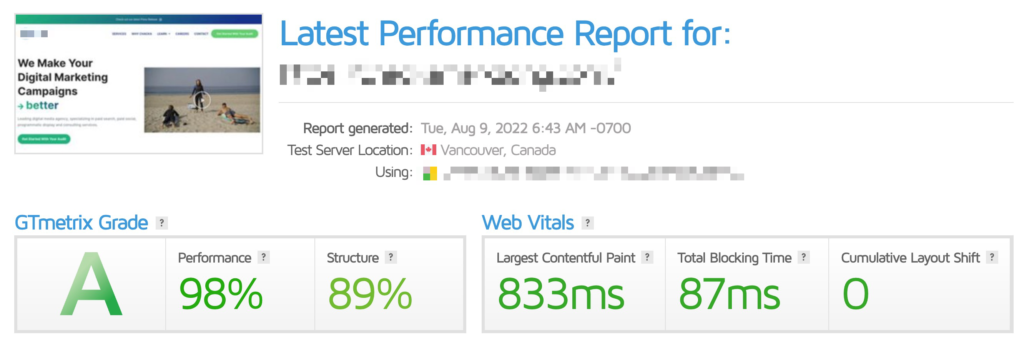
GTMetrix

A small business website redesign can optimize your site’s speed, providing a better experience for users and helping your site perform better in search results. Google cares increasingly more and more about how fast your website loads when it makes decisions on who ranks for what terms in search. Additionally, if users sit around while your website takes 5+ seconds to load, they will bounce (leave). Often, they aren’t coming back. Consumers are expectant of fast-loading websites. Just think about it when you personally browse websites. Are you patient? Probably not! (pssss…we aren’t either!) Your small business website is no different, and your potential customers don’t have time to wait around. If your website is slow, it’s time for a redesign for your small business website.

Pro Tip: Use GT METRIX to test your website’s speed! An “A” grade is what we shoot for with all of our website maintenance plan customers.

3. Outdated Website Design

small business website redesignWeb design trends change more rapidly than you think! A website that looked modern and cutting-edge just a few years ago might now appear outdated and unattractive, even though you as the business owner are used to it. As small business owners, we can often think that our own website is “fine still,” while we judge others’ websites and call them outdated. An old-fashioned website can make visitors question the professionalism and relevance of your business. At hypersite, we often hear small business owners say “wow…I didn’t even know that was going on these days in website world.” If your site feels outdated, a small business website redesign can breathe new life into your online presence.


4. Low Website Conversion Rates

If you’re not seeing the conversion rates you want from your website, it might be due to design issues. What is conversion rate? Take the number of new leads or sales you receive from your website each month, and divide it by the number of total visitors to your website that same month. For example, you received 10 new leads from your website in a month, and 200 total visitors. This would be a 5% conversion rate. There is no “industry standard” conversion rate number, as it varies by industry, and can vary widely depending on how much traffic you get to your website in general. Just know that higher is better! And an outdated website in need of a website redesign can result in a low conversion rate. A small business website redesign focused on user experience and conversion rate optimization can help turn your site into a more effective marketing tool.

Pro Tip: Use Google Analytics (for FREE!) to track your website visitors and your conversion rate. Unfortunately, it’s not super easy to set up. Our team can help if you need help with that setup!


5. Your Business Has Evolved or Changed

Many small business owners gets complacent with updating their website as their business changes over the years. As your business grows, your website should reflect that growth. Maybe you’ve added new products or services, changed your target audience, or updated your branding. If your current website no longer accurately represents your business, a small business website redesign can align your website with your current business goals and identity. At hypersite, we see small business owners wait entirely too long to bring their website up to the standards of where their current business is. If your company started out targeting small businesses, but now you have shifted and are focused on much larger companies for your ideal customer profile – your website needs to reflect that! Don’t forget that your website is largely the front door for almost all new business that comes in.


6. Poor Website User Experience (UX)

UX (short for “User Experience”) is all about how visitors interact with your website. If users find it hard to navigate your site or can’t quickly find the information they need, they’re likely to leave and never return. UX is one of those things that changes quickly with society. As new apps launch and get popular, users get used to navigating digital experiences in certain ways. A couple examples of ways we interact with digital experiences now that we didn’t just a few years ago:

  1. Swiping down from the top of the screen to refresh the page on mobile
  2. Long-press on screen items to see a menu of action options
  3. Expecting all important info to be on the website home page instead of having to dig through the main navigation to find pertinent information in other places on the website

Ineffective navigation, complicated forms, poor content structure, and inconsistent design elements can all lead to a poor user experience. If visitors aren’t staying on your site or engaging with your content, it’s time to think about a small business website redesign focused on UX.


7. You’re Not Keeping Up With Competitors

In the digital world, keeping pace with or staying ahead of your competitors is key. If your competitors’ websites offer better user experiences, more features, or a more appealing design, you might lose potential customers to them. This trigger in particular is very industry-specific. You may find that while the world at large has not embraced a certain web design style, layout or function, your industry has. Examples here might include a competitor laying out their home page in a certain way, or adding certain functionality to offer potential customers. Regularly assess your competition and ask yourself whether your website stands up. If not, a small business website redesign could be necessary to give you a competitive edge.

Pro Tip: our team would LOVE to help you toss around the idea of whether a small business website redesign is something you should consider! Simply use the Get Started button on your screen to reach out. We’d love to say hello and hear more about your small business website redesign needs.


In Conclusion: Do You Really Need A Small Business Website Redesign?


A small business website redesign is an opportunity to improve your website’s functionality, aesthetics, and overall performance. It’s an essential part of maintaining a successful digital presence that effectively represents your brand and resonates with your target audience. If your site looks great, but it’s overwhelming to stay up to date with all of the maintenance, you might consider a website maintenance plan or a WordPress consultant!

WordPress maintenance vs management is the single most expensive misunderstanding in the WordPress services market, and most agencies actively make it worse.

Quick answer: In the WordPress maintenance vs management comparison, maintenance is the technical upkeep that keeps a site running — updates, backups, security scanning, uptime monitoring. Management includes all of that and adds ownership of the site’s direction and performance. Maintenance keeps the site alive. Management is accountable for what it does.

Most providers reduce WordPress maintenance vs management to two tiers sitting side by side on a pricing page. Pick one.

That framing is wrong, and it is why so many businesses sign a contract expecting one thing and receive the other. Maintenance and management are not siblings. Management is the superset that contains maintenance. Every genuine management engagement includes the full maintenance task list. No maintenance plan includes management.

Get the WordPress maintenance vs management decision wrong and you end up with a site that is perfectly updated, perfectly backed up, perfectly secure — and going nowhere.


WordPress maintenance vs management at a glance

 WordPress MaintenanceWordPress Management
Core questionIs the site working?Is the site working for the business?
PostureReactive and scheduledProactive and strategic
Who decides what changesYou do. The provider executes.The provider recommends. You approve.
ScopeUpdates, backups, security scans, uptime monitoringEverything in maintenance, plus performance, content, SEO, conversion, roadmap
Monthly deliverableA completed-tasks reportA performance report with recommendations
Measured byUptime, patch currency, backup successTraffic, rankings, conversions, revenue
Accountable for outcomesNoYes
Typical US cost$50–$200/mo$250–$2,000+/mo
If you skip itThe site breaksThe site quietly stops competing

WordPress maintenance vs management: the 7 critical differences

Seven differences do the real work in WordPress maintenance vs management. Everything else is a variation on them.

1. Detection. Under maintenance, you notice problems first. Under management, your provider does.

2. Decision-making. Maintenance executes your instructions. Management forms its own recommendations.

3. Accountability. Maintenance is accountable for tasks completed. Management is accountable for business outcomes.

4. Scope boundaries. Maintenance has a fixed task list. Management has a roadmap that changes with your goals.

5. Reporting. Maintenance reports what was done. Management reports what happened and what to do next.

6. Judgement. Maintenance keeps your existing plugins updated. Management questions whether you should be running them at all.

7. Direction. Maintenance preserves the status quo. Management moves the site somewhere.


What WordPress maintenance actually covers

WordPress maintenance is the recurring technical work required to keep an installation secure, current and available. Whether you run the list in-house or buy WordPress maintenance services from an agency, that list barely changes month to month:

  • Core, plugin and theme updates, staged and tested before they touch production
  • Offsite backups with periodic restore tests — an untested backup is a guess
  • Security scanning and malware monitoring, plus firewall rules and login hardening
  • Uptime monitoring with alerting
  • Database optimisation — post revisions, expired transients, orphaned tables
  • Broken link and 404 monitoring
  • PHP compatibility checks ahead of host-forced version bumps
  • A monthly report confirming what was done

That is the whole category. It is genuinely valuable and genuinely finite.

The defining characteristic is that the provider is not deciding anything. If your plugin roster is wrong, maintenance keeps the wrong plugins updated. If your homepage does not convert, maintenance keeps a non-converting homepage online with excellent uptime.


What WordPress management adds on top

Management contains the full maintenance list, then adds responsibility for direction and performance. That is the line between buying a maintenance plan and buying website management services: one keeps the site current, the other is answerable for what it achieves.

You cannot manage a site you are not maintaining. You can absolutely maintain a site nobody is managing — and a great many businesses are doing exactly that.

Management adds performance ownership, content and publishing, SEO oversight, conversion work, roadmap planning, vendor coordination, and reporting that ties site metrics to business outcomes.


The one test that settles WordPress maintenance vs management

Ignore the feature list. Ask one question:

When something on your site should change, who notices first?

Under maintenance, you notice. You find the broken contact form when a customer complains, email your provider, and they fix it — billing you if it falls outside scope. Detection sits with you. That is not a failure; it is how maintenance is designed.

Under management, your provider notices, and comes to you with a diagnosis before you have seen the problem.

Detection order matters more than response time. If your provider’s first awareness of a problem is your email, a two-hour response SLA is irrelevant. The delay already happened, and it was measured in days.


Why “my host handles updates” is dangerously wrong

This is the costliest misunderstanding inside the WordPress maintenance vs management question, and the documentation is partly to blame.

Plugin and theme auto-updates are off by default in WordPress. The explicit statement lives on make.wordpress.org rather than user-facing docs. There is a setting called plugins_auto_update_enabled that defaults to true, which is easy to misread as auto-updates being on. It only controls whether the interface elements display.

More significantly: any plugin or theme not hosted in the WordPress.org directory receives no automatic updates at all. The update check is a single request matched by directory slug, so a commercial product produces no result. If you run a premium theme or paid plugins — and most business sites do — that entire portion of your attack surface is invisible to every automatic mechanism in the platform.

The scale is not small. Patchstack recorded 11,334 new WordPress vulnerabilities in 2025, a 42% year-on-year rise, with 91% in plugins. (Patchstack, State of WordPress Security in 2026)

Here is why that lands on the management side of the WordPress maintenance vs management line. Patching on schedule is a checklist task. Deciding which plugins are worth their attack surface, keeping a tracked manual process for every commercial product the auto-updater cannot see, and noticing when a vendor has abandoned a plugin — those are judgement calls. No checklist produces them.

One honest caveat. The widely repeated claim that plugin vulnerabilities cause most WordPress compromises is not currently sourced. The 91% figure describes the vulnerability catalogue, not breach causes. The most recent hacked-site telemetry, Sucuri’s 2023 report, found 13.97% of compromised sites had a vulnerable component present — presence, not cause. Meanwhile Wordfence blocked 55 billion password-hacking attempts against 48 billion vulnerability-targeting requests in 2024, and both vendors name stolen credentials as the rising intrusion source. (Wordfence, 2024 Annual WordPress Security Report)

Which is itself the argument. Maintenance patches. Management looks at where the evidence points and fixes your credential controls too.


WordPress maintenance vs management in five real scenarios

ScenarioMaintenance onlyFull management
Critical plugin vulnerability disclosedPatched next scheduled cycleIdentified, staged, tested, deployed — including commercial plugins no auto-updater reaches
Traffic spike overloads the serverSite slows; you hear it from visitorsLoad monitored, resources scaled before users notice
Rankings decline over three monthsYou find it in Analytics weeks laterFlagged in the monthly report with a fix
Contact forms stop capturing leadsYou find out when prospects stop callingConversion tracking catches it and escalates
Seasonal campaign needs a new featureYou request a quote; billed separatelyProposed proactively as part of the roadmap

That is WordPress maintenance vs management in practice: maintenance keeps the engine running, management drives the car somewhere.


Where hosting and support fit into WordPress maintenance vs management

Managed WordPress hosting covers the server: infrastructure uptime, server-side caching, platform security, sometimes automatic core updates. It does not cover anything inside your install. If a plugin update breaks your checkout, your host will tell you that is not their problem.

WordPress support services are reactive help on request. Something breaks, you open a ticket, someone fixes it. Support is measured in response time. Maintenance is measured in prevention.

The clean hierarchy:

  1. Hosting — where the site runs
  2. Maintenance — keeping what runs healthy
  3. Support — fixing what breaks
  4. Management — all of the above, plus deciding what should change and owning the result

WordPress maintenance vs management: which does your business need?

Your decision is not which to pick. It is how far up the hierarchy your site needs to go.

WordPress maintenance vs management: choose maintenance when…

  • The site is primarily informational, changing infrequently
  • It is not central to lead generation or revenue
  • Someone internal can handle edits and recognise breakage
  • You accept being first to notice problems, because the stakes are lower

Paying management rates here is a waste. Buy good maintenance and spend the difference elsewhere.

WordPress maintenance vs management: choose management when…

  • The site supports lead generation, ecommerce or donations
  • Downtime or slow performance has material financial impact
  • You cannot describe the site’s roadmap for the next year
  • Multiple integrations create dependencies nobody is watching
  • Nobody internally owns the site’s performance

This is the most expensive gap we see: a site receiving excellent maintenance, no downtime in two years, and not one ranking position gained. The provider did nothing wrong — nobody asked them to.

If you are losing leads because something broke and nobody noticed for days, you do not have a maintenance problem. You have a management gap.

Start with maintenance, upgrade later when…

You are early, budget is tight, and the site is not yet a primary channel. Set a trigger and revisit. The mistake is not starting with maintenance — it is staying there for four years while expecting management outcomes.


Five questions that settle WordPress maintenance vs management before you sign

  1. Who decides what changes on my site? “You tell us” means maintenance.
  2. How do you detect issues, and how fast? Management describes monitoring, alerting and SLAs.
  3. Do you test updates in staging first? Lower tiers push straight to production.
  4. What is in the monthly report? Completed tasks is maintenance. Metrics with recommendations is management.
  5. What is out of scope, and what does it cost? A provider who cannot answer quickly has not thought about it.

Red flags

  • A plan marketed as management, priced at maintenance rates, with no strategic work
  • No proactive monitoring beyond a basic uptime check
  • No tracked process for commercial plugins and themes
  • The provider has never contacted you first. You always initiate.

Audit which side of WordPress maintenance vs management you are paying for

  1. Review the last three issues. Did your provider flag them, or did you?
  2. Check six months of reports. Tasks, or metrics with recommendations?
  3. Count your commercial plugins and themes — those get nothing automatically.
  4. Map the site’s business role. Revenue or leads means maintenance alone is insufficient.
  5. Match spend to need. Do not overpay on a brochure site; do not underpay on a revenue site.

WordPress maintenance vs management FAQ

What is the difference between WordPress maintenance vs management?

Maintenance is scheduled technical upkeep — updates, backups, security scanning, uptime monitoring. Management includes every maintenance task and adds ownership of performance, content, SEO and business outcomes. Maintenance sits inside management rather than beside it, which is why every management plan includes maintenance but no maintenance plan includes management.

No. Managed hosting is a server product covering infrastructure, caching and platform security. Management is a service relationship covering everything inside your site, including strategy. You can have both, and most active business sites should.

Over the past six months, has your provider contacted you about a performance decline or a ranking drop before you noticed? Do reports contain recommendations, or only completed tasks? If the answer to both is no, you are receiving maintenance regardless of what the invoice says.

Yes, and many businesses should. As traffic and revenue dependence grow, the cost of nobody noticing problems first grows with them. Most providers offer stackable tiers that make the transition straightforward.

In the US market, WordPress maintenance plans typically run $50–$200 per month. Management generally starts around $250 and rises with scope, commonly reaching $1,000–$2,000 where the provider owns SEO, content and conversion work.

Because plugin and theme auto-updates are off by default in WordPress, and anything outside the WordPress.org directory receives no automatic updates at all. Most business sites run at least one commercial theme or paid plugin, so the platform’s automatic machinery cannot reach a meaningful part of the attack surface.

Yes, and for a simple site it is reasonable. Budget two to four hours a month. The failure mode is not incompetence — it is the third consecutive month where something more urgent came up.

With proper monitoring, critical issues should be detected within minutes and a six-business-hour response is a reasonable benchmark. But detection matters more than response. If your provider’s first awareness comes from your email, the delay already happened.

The site stays secure, current and online. It will not improve. Over two or three years, competitors actively managing their sites will out-rank and out-convert you, and your maintenance reports will show green the entire time.

WordPress maintenance vs management: the short version

The WordPress maintenance vs management question comes down to this: maintenance answers “is the site working?” Management answers “is the site working for the business?” One is contained inside the other, and confusing them is the most common reason businesses feel let down by a provider who is technically delivering exactly what was purchased.

Work out which question you need answered, then buy accordingly.

Search

Popular Posts

Small Biz Website Tips Newsletter

Stay up to date with the latest marketing, sales, and service tips and news.

Small Biz Website Tips Newsletter

Stay up to date with the latest marketing, sales, and service tips and news.